Thailand’s Ministry of Education has reaffirmed that all children, regardless of nationality or legal status, are entitled to full access to the national school system for the 2025 academic year.
By Chainarong Monthienvichienchai
The clarification comes as regional instability, including unrest in Myanmar and tensions along the Thai-Cambodian border, has displaced thousands of families, raising concerns about access to education for migrant, refugee, and stateless children in Thailand.
On February 3, Mr. Pichet Phophakdee, secretary-general of the Office of the Basic Education Commission (OBEC), addressed growing online concerns regarding the admission of students without civil registration.
He emphasized that Thailand’s commitment is firmly rooted in the Convention on the Rights of the Child (CRC) and a landmark 2005 Cabinet resolution.
Under the newly reinforced guidelines, schools are instructed to use a “G Code,” a specialized 13-digit identification, to register students who lack official Thai documentation.
This “G Code” allows migrant and stateless children to be officially counted, enabling schools to receive per-head government subsidies needed to provide instruction.
“Regardless of race or nationality, all children under the jurisdiction of the Thai state must receive equal protection,” Mr. Pichet said.
He added that access to basic education is a key tool for “reducing social problems, enhancing public health, and promoting long-term national security.”
The Church as a Shepherd on the Frontier
The Catholic Church in Thailand has emerged as a key partner in extending educational access to displaced and vulnerable children, particularly in border areas affected by conflict.
While government policy provides the legal framework, Catholic institutions often deliver direct support in volatile zones.
Fr. Paul Eakarat Homprathum, secretary-general of the Catholic Education Council of Thailand, highlighted the Church’s role in accompanying children fleeing violence and displacement.
“In Thailand, the Catholic Church has been actively working to support children from Myanmar, especially those who are refugees or migrants,” Fr. Paul said.
He noted that while the influx of students from Cambodia has halted following the closure of borders due to clashes since last year, the need for pastoral sensitivity and educational support remains acute.
“The right to education is a fundamental human right, rooted in the dignity of the person. It is not a privilege granted by the state but a duty to be protected for the common good of the human family,” the Compendium of the Social Doctrine of the Church states.
Mercy in Action: The Bamboo School
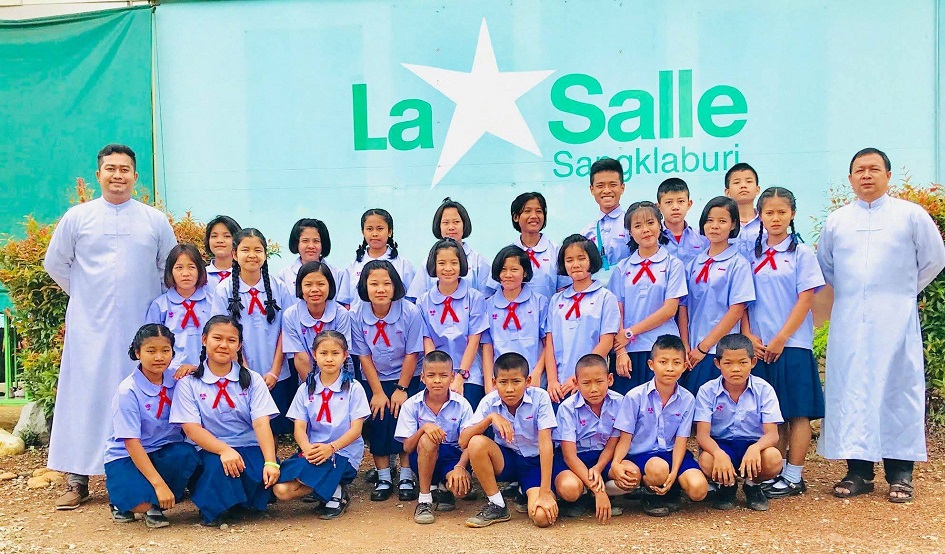
One example of this commitment is the Bamboo School in Kanchanaburi province, operated by the De La Salle Brothers.
The school serves approximately 500 students, many of whom cross daily from Myanmar or live on campus after being abandoned or orphaned.
Founded in 2008, the school provides a holistic education that includes:
- Language integration: Intensive Thai and English programs to help students adapt to the national curriculum.
- Vocational pathing: Skills training aimed at long-term self-sufficiency.
- Trauma-informed care: Mental health support for children affected by conflict and displacement.
The Ministry of Education has acknowledged that some members of the public express concern that enrolling non-citizen children could strain resources or pose security risks.
OBEC, however, maintains that integrating these children into the formal education system, rather than excluding them, strengthens social stability.
Through partnerships with international organizations such as UNICEF and the International Organization for Migration, as well as Catholic groups including Caritas Thailand and COERR, the “Education for All” policy seeks to turn border regions from sites of exclusion into spaces of shared responsibility.
As displaced children enter Thai classrooms this year, education officials and faith-based institutions say access to schooling offers more than instruction.
For many families, it represents a first step toward safety, dignity, and a more secure future
Source: The Herald